

What is a notary seal meaning in U.S. law?
A notary seal is the official impression a notary public places on a document to certify that a notarization has taken place. It is not decorative. According to the National Notary Association, the seal's presence on a notarial certificate gives the document considerable legal weight, rendering it prima facie evidence of authenticity in a court of law. Banks, government agencies, and courts all rely on this mark as confirmation that a commissioned notary personally verified the signer's identity and witnessed the act.
The term "notary seal" technically refers to the impression itself, not the tool used to make it. The tool can be an inked rubber stamp or a metal embosser. Both produce the seal, but the impression is what carries legal force.
Every valid notary seal in the United States must display at minimum:
- The notary's full legal name, exactly as it appears on their commission
- The words "Notary Public"
- The state that issued the commission
These three elements are universal across all 50 states. Most states add further requirements, which are covered in detail below.
Table of Contents
- What types of notary seals are used today?
- How do notary seal requirements vary by state?
- How should you use and maintain a notary seal properly?
- What legal authority does a notary seal carry in the United States?
- Which documents commonly require a notary seal?
- What happens when a notary seal is used improperly or fraudulently?
- How does the notarization process work, step by step?
- Key Takeaways
- Need a notary seal on your documents?
What types of notary seals are used today?
Three main types of notary seals are in active use across the United States: ink stamps, embossers, and digital seals. Each serves the same legal purpose but differs in format, compatibility, and state acceptance.
| Seal Type | Format | Photocopy/Scan Friendly | Common Use |
|---|---|---|---|
| Ink stamp | Flat inked impression | Yes | Primary seal in most states |
| Embosser | Raised metal indentation | No | Supplemental or legacy-mandated |
| Digital seal | Electronic certificate embedded in document | Yes (digital) | Remote and electronic notarizations |
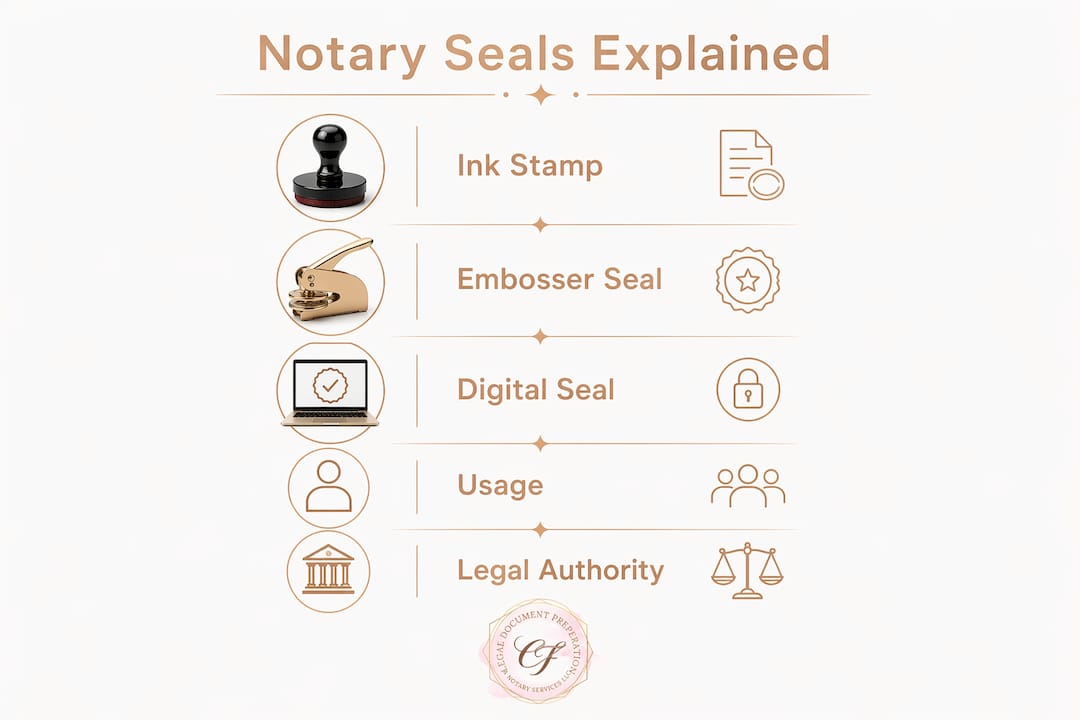
Ink stamps are the most widely used tool because they produce flat, photocopiable impressions that scan clearly. Most states have moved to ink stamps as the required primary seal for exactly this reason. Embossers create a raised indentation that does not reproduce well on photocopies or scans, which limits their practical value in a document-heavy world. They remain useful as a supplemental security layer on high-value transactions, but most states no longer accept them as the sole official seal.

Digital seals function identically to physical seals in remote online notarization and are a key example of how digital notary seals ensure legality and authenticity in remote or electronic notarization. Learn more. They take the form of a digital certificate embedded within the electronic document, carrying the same identifying information as a physical stamp. As remote notarization has expanded across the country, digital certificates have become a standard, legally enforceable equivalent to the ink stamp.
How do notary seal requirements vary by state?
Because notary law is entirely state-based, with no federal statute governing seal requirements, the variation across jurisdictions is real and consequential. The Revised Uniform Law on Notarial Acts provides a model framework, but only some states have adopted it. Every notary must verify their specific Secretary of State's mandates before ordering a seal.
| Requirement | Universal? | Notes |
|---|---|---|
| Notary's full legal name | Yes, all states | Must match commission exactly |
| "Notary Public" | Yes, all states | Exact wording required |
| State of commission | Yes, all states | Full state name typically required |
| Commission expiration date | Most states | A handful make it optional |
| Commission number | Many states | Omitting it is a frequent, costly mistake |
| County of commission | Some states | Required where notary filed their commission |
| State seal or emblem | A few states | Some states explicitly prohibit it |
West Virginia, for example, requires the words "Official Seal," "Notary Public," "State of West Virginia," and the notary's name, address, and commission expiration date, all within a rectangle no larger than 1 inch by 2½ inches. California requires a photographically reproducible seal in specified ink colors and restricts embossers as the sole seal. Tennessee has its own format specifications published by the Secretary of State.
Ink color is another variable. Most states require black ink because it photocopies and scans clearly, though some states permit or specify other colors. Seal shape, whether rectangular or circular, also varies by state. Getting any of these details wrong can result in rejected documents and the need to repeat the entire notarization.
Pro Tip: Before ordering your notary stamp, download your state's current notary handbook directly from the Secretary of State's website. Requirements change, and a seal ordered from outdated guidance may be non-compliant from day one.
How should you use and maintain a notary seal properly?
The notary seal must be personally affixed by the commissioned notary. It is not a substitute for the notary's signature; both are required on every notarial certificate. Using the seal without signing, or signing without the seal, leaves the notarization incomplete and legally unenforceable.
Proper maintenance protects both the notary and the people relying on their work. Key practices include:
- Store the seal in a locked drawer or secure location when not in use
- Never allow another person to use your seal, even temporarily
- Replace ink pads before impressions become faint or unreadable
- Destroy the seal immediately upon commission expiration, resignation, or revocation
- Report a lost or stolen seal to your state's commissioning authority promptly, as many states mandate this by law
Using a seal after commission expiration or with missing required elements can lead to document rejection and legal penalties. Some states classify seal misuse as a misdemeanor, carrying fines and disqualification from future commissioning.
Pro Tip: For high-value transactions such as real estate deeds or powers of attorney, use both an ink stamp and an embosser. The ink stamp satisfies the legal requirement; the embosser adds a physical security layer that is difficult to replicate.
What legal authority does a notary seal carry in the United States?
The notary seal functions as a personal badge of state authority. It is tied directly to the individual notary's commission number and name, making it traceable and accountable in a way that a simple signature alone is not.

Experts consistently emphasize that the seal is a regulated legal instrument, not a formality. It converts a private document into one that courts, banks, and government offices presume authentic without requiring additional proof. That presumption of authenticity is what makes notarized documents so widely accepted across institutions and state lines.
The digital evolution of the seal has not diminished this authority. Digital certificates used in remote online notarization carry the same identifying data as a physical stamp and maintain equivalent legal enforceability. The National Association of Secretaries of State has published standards specifying that an electronic notarial certificate must bear the notary's electronic signature or official electronic seal, official title, and all required commission information.
Cristina Fernandez, a certified legal document preparer and immigration paralegal at Cflegalformhelp, works with notarized documents daily across Florida. Understanding the seal's legal function is central to verifying signer identification and producing documents that hold up in court, at the bank, and with immigration authorities.
Which documents commonly require a notary seal?
A notary seal is required on any document where the law or a receiving institution demands certified proof of identity and voluntary signature. Common examples include:
- Real estate deeds and mortgage documents: Most states require notarization for property transfers and loan closings.
- Powers of attorney: Both financial and medical powers of attorney typically require a notarized seal to be legally valid.
- Wills and trusts: Some states require notarization; others use it to create a self-proving will that simplifies probate.
- Affidavits and sworn statements: Courts and government agencies require notarized affidavits to confirm the signer swore under oath.
- Immigration forms: USCIS and immigration courts frequently require notarized supporting documents and certified translations.
- Divorce agreements and parenting plans: Florida courts, for example, require notarized signatures on marital settlement agreements.
- Vehicle title transfers: Many states require notarized signatures on title documents to prevent fraud.
- Business formation documents: LLC operating agreements and certain filings may require notarization depending on the state.
If you are preparing documents for use outside the United States, the notary seal is often the first step in a longer authentication chain. Learn more about documents for overseas use and how the seal fits into apostille and consular legalization processes.
What happens when a notary seal is used improperly or fraudulently?
Misuse of a notary seal carries serious legal consequences, both for the notary and for anyone who knowingly submits a fraudulently notarized document. The consequences fall into several categories.
Document rejection is the most immediate outcome. A seal with missing required elements, illegible ink, or an expired commission date gives the receiving institution grounds to reject the document outright. The entire notarization must then be redone, which can delay closings, court filings, and immigration applications.
Civil liability can follow if a party suffers financial harm because a defective notarization was accepted and later challenged. Notaries carry errors and omissions insurance for this reason, though coverage depends on the nature of the mistake.
Criminal penalties apply in cases of fraud. Using a seal after commission expiration, forging a notary seal, or notarizing a document without the signer present are criminal acts in most states. Some states classify these offenses as misdemeanors; others treat deliberate fraud as a felony. Penalties can include fines, imprisonment, and permanent disqualification from serving as a notary.
A lost or stolen seal must be reported to the state commissioning authority without delay. Failing to report it leaves the notary potentially liable for any fraudulent use that occurs in the interim.
How does the notarization process work, step by step?
The notarization process follows a clear sequence. Each step matters, and the seal appears at the end, not the beginning.
-
The signer presents the document and valid identification. The notary reviews a government-issued photo ID to confirm the signer's identity before anything else happens.
-
The notary confirms the signer's willingness. The signer must be acting voluntarily. If there is any sign of coercion, the notary must refuse.
-
The signer signs the document in the notary's presence. For acknowledgments, the signer may have signed earlier but must personally acknowledge the signature to the notary. For jurats, the signer must sign in front of the notary and swear or affirm the document's truthfulness.
-
The notary completes the notarial certificate. This written statement specifies what type of notarial act was performed, the date, and the state and county where it occurred.
-
The notary signs the certificate. The notary's signature must match the name on their commission exactly.
-
The notary affixes the seal. The ink stamp is pressed clearly onto the notarial certificate, adjacent to the signature. Every required element must be legible. If the impression is faint or smeared, the notary should re-stamp on a clean area of the certificate rather than submit an unreadable seal.
-
The notary records the act in their journal. Most states require or strongly recommend a notary journal entry for every notarization, capturing the date, document type, signer's name, ID type, and fee charged.
The seal at step six is what converts the certificate from a private statement into a legally recognized notarial act. Without it, the document lacks the official authentication that courts, banks, and agencies require. For state-specific guidance on Florida notarizations, Cflegalformhelp maintains a detailed Florida notarization checklist that walks through each requirement.
Key Takeaways
A notary seal is the official, state-regulated impression that converts a notarial certificate into prima facie legal evidence, recognized by courts, banks, and government agencies across the United States.
| Point | Details |
|---|---|
| Three universal elements | Every U.S. notary seal must show the notary's full legal name, "Notary Public," and the state of commission. |
| Ink stamps are the standard | Most states require ink stamps as the primary seal because they photocopy and scan clearly. |
| State requirements vary | About a dozen states follow the Revised Uniform Law; all others set their own seal rules. |
| Seal misuse carries penalties | Using an expired or defective seal can result in document rejection, civil liability, or criminal charges. |
| Digital seals are legally equivalent | Electronic notary seals carry the same identifying data and legal enforceability as physical stamps. |
Need a notary seal on your documents?
Cflegalformhelp provides professional notarization services across Florida, including mobile notary visits, remote online notarization, and loan signing. Whether you need a single document notarized or a full package prepared for court, immigration, or a real estate closing, the team at Cflegalformhelp handles it with accuracy and bilingual support in English and Spanish.
Legal document preparation and notarization services are available at flat, transparent fees with no hidden costs. Reach out to Cflegalformhelp to get your documents properly prepared, signed, and sealed.