

Two-witness requirements exist as a legal evidentiary safeguard — they prevent fraud, confirm the signer's mental capacity, and prove the document was executed voluntarily. When a will, deed, or power of attorney carries two independent witness signatures, courts and recording offices have corroborating testimony from multiple sources if the document is ever challenged.
The three core functions of a witness signature are:
- Verify identity and presence: Each witness confirms the signer was physically present and appeared to be the person named in the document.
- Attest capacity and voluntariness: Witnesses observe whether the signer seemed competent and free from pressure at the moment of signing.
- Provide independent attestation: If a dispute arises in probate or a title proceeding, two witnesses give the court two separate accounts rather than one that could be dismissed.
A practical example: under Florida Statutes § 732.502 (2025), a will is only valid if the testator signs in the presence of at least two attesting witnesses, who then sign in the presence of the testator and each other. Miss one step, and the will can be denied probate.
Pro Tip: Before any signing, look up your state's code for the specific document type. Many states also require witnesses to be "disinterested," meaning they cannot be named as a beneficiary or appointed agent in the document itself.
Key Takeaways
Two-witness requirements are a legal evidentiary safeguard that prevents fraud, confirms capacity, and protects documents from being challenged in probate or recording proceedings.
| Point | Details |
|---|---|
| Two witnesses, not one | Two independent witnesses reduce perjury risk and provide corroboration if one witness is unavailable during a dispute. |
| Disinterested status matters | Witnesses must not be named in the document; a beneficiary or appointed agent is disqualified in most states. |
| State rules vary significantly | Florida requires two witnesses for wills and durable POAs; Texas allows holographic wills with no witnesses at all. |
| Witnesses and notaries are different | A witness attests to the signing event; a notary verifies identity and creates an official record. Many documents require both. |
| Cflegalformhelp coordinates the process | Cflegalformhelp provides flat-fee document preparation, mobile notary services, and witness coordination for Florida signings. |
Table of Contents
- Why do some documents need two witnesses?
- The legal rationale behind requiring two witnesses
- Which documents commonly require two witnesses?
- How does a witness signature differ from a notary acknowledgment?
- Who qualifies as a witness?
- What can you do if you can't find two witnesses?
- How witness requirements differ by state
- How to choose witnesses and avoid common mistakes
- When should you call a notary or document-prep service?
- A practitioner's perspective on witness requirements
- Cflegalformhelp makes proper document execution straightforward
- Sources
Why do some documents need two witnesses?
A witness, in the legal sense, is an adult who observes a signing event and can later testify that it happened. That testimony covers three things: the signer was present, the signer appeared mentally competent, and no one appeared to be forcing or pressuring them. The witness signature on the document is a written record of that observation.
What a witness does not do is equally important to understand. A witness does not verify the signer's identity the way a notary does, does not provide legal advice, and does not certify the document's content is accurate or lawful. Their role is narrower and more specific: they saw the signing happen, and they can say so under oath if asked.
Consider a will dispute where a family member claims the testator lacked mental capacity at the time of signing. Two witnesses who were present can each testify independently about the testator's demeanor, coherence, and apparent understanding of what they were signing. One witness account can be challenged; two independent accounts from people with no stake in the outcome are considerably harder to dismiss. That is the practical weight a witness signature carries in legal documents needing validation.
The legal rationale behind requiring two witnesses
Two witnesses, rather than one, is not an arbitrary number. The requirement reflects a deliberate legal judgment about evidentiary reliability.
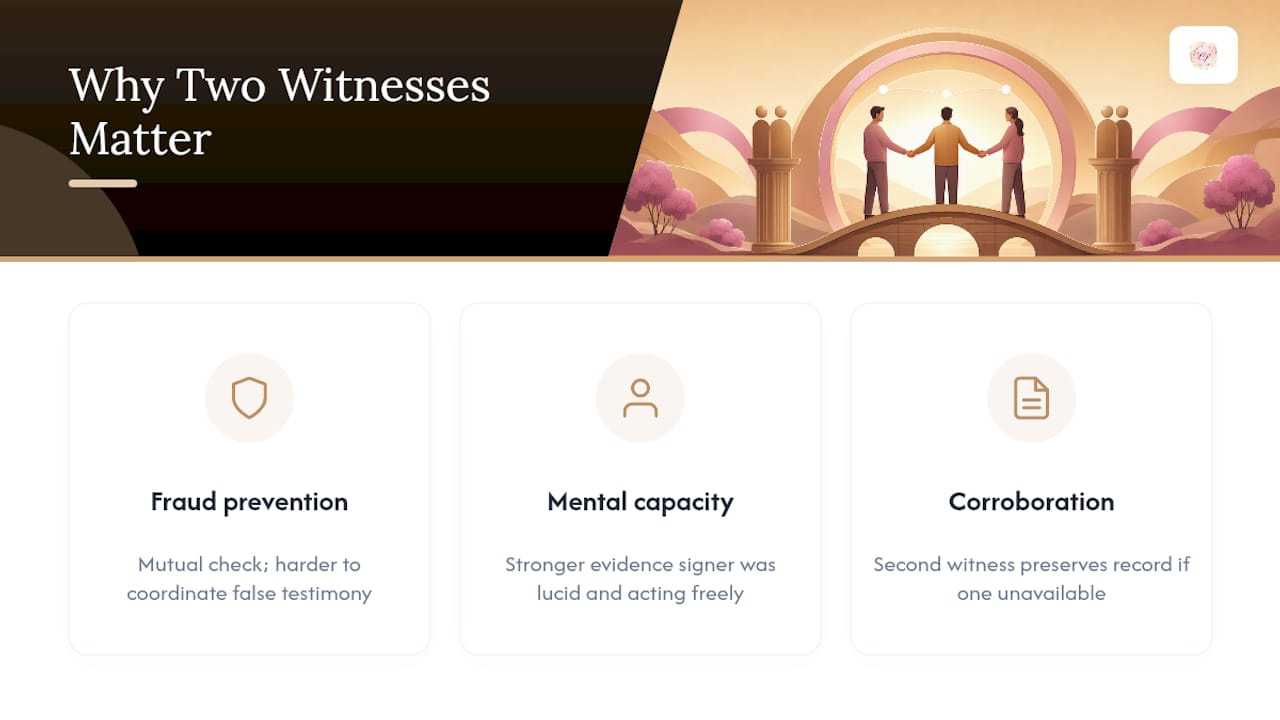
Fraud prevention is the most direct reason. A single witness who is willing to lie can fabricate a signing event. Two independent witnesses who must each sign in the presence of the other create a mutual check. Coordinating false testimony between two people is harder, and courts treat corroborated accounts as more credible.
Attestation of mental capacity adds a second layer. Conditions like dementia or undue influence can affect a signer's judgment without being obvious to a single observer. Two witnesses independently observing the same signing provide stronger combined evidence that the signer was lucid and acting freely.
Contemporaneous corroboration addresses what happens when one witness becomes unavailable. If a witness dies, moves away, or simply cannot be located by the time a document is contested, the second witness's account preserves the evidentiary record. Courts and probate judges rely on this redundancy.
The historical basis for the two-witness rule traces to English common law, where formal instruments like wills and deeds required multiple witnesses as a procedural signal of seriousness. The Statute of Frauds (1677) and the Statute of Wills (1540) both embedded multi-witness requirements into Anglo-American legal tradition. U.S. states inherited and adapted those rules, which is why most U.S. states require two witnesses for a will and impose varying witness rules for powers of attorney and deeds.
Which documents commonly require two witnesses?
Witness requirements are not universal across all legal documents. They concentrate in instruments where the stakes are high and the risk of fraud or incapacity is greatest.
Documents that frequently require two witnesses include:
- Wills and testamentary documents: Most states require two witnesses, and the signing-in-presence rules are strict. A will executed without proper witnesses can be denied probate entirely.
- Durable powers of attorney: Many states require two witnesses for a durable POA, particularly when it grants broad financial authority. Florida, for example, requires two witnesses for a durable POA in addition to notarization.
- Advance healthcare directives and living wills: Some states require two witnesses to confirm the signer understood and voluntarily chose their healthcare preferences.
- Certain deed transfers and conveyances: Requirements vary significantly by state. Some states require witnesses for deeds to be recorded; others rely solely on notarization.
Standard commercial contracts, promissory notes, and most business agreements generally do not require witness signatures. Notarization alone often satisfies recording requirements for those instruments. The distinction matters: certain documents commonly combine witness signatures and notarization — wills, powers of attorney, and deeds — because dual verification reduces fraud risk and strengthens enforceability.
How does a witness signature differ from a notary acknowledgment?
The two roles are legally distinct, and confusing them can leave a document defective.
A witness attests to the signing event itself. They confirm the signer was present, appeared competent, and signed voluntarily. They do not verify the signer's identity through official means, and they do not create any state record.
A notary verifies the signer's identity (typically through government-issued photo ID), administers an oath or affirmation if required, and completes an official notarial certificate with a seal. Notarization verifies the signer's identity and records an official notarial act; it is legally distinct from witness signatures and is sometimes used alongside them to strengthen evidentiary value.
| Function | Witness | Notary |
|---|---|---|
| Confirms signer was present | Yes | Yes (incidentally) |
| Verifies signer's identity (official) | No | Yes |
| Attests voluntariness and capacity | Yes | Partially |
| Creates an official state record | No | Yes |
| Applies a seal or certificate | No | Yes |
Many high-stakes documents require both. A durable power of attorney in Florida needs two witnesses and a notary. A deed recorded in many counties must carry both a notarial acknowledgment and witness signatures. When a document requires both a notary and witnesses, the signing must satisfy both sets of procedural rules, and notaries do not always supply witnesses. You may need to arrange witnesses separately before or during the notarial act.
For a deeper look at how these roles interact, the Cflegalformhelp guide on notary, witness, and signer roles breaks down each function clearly.
Who qualifies as a witness?
Witnesses must generally be competent adults, but the specific eligibility rules vary by state and by document type. The most common requirement across jurisdictions is that a witness be disinterested, meaning they have no financial or personal stake in the document's outcome.
Common eligibility constraints include:
- Minimum age: Most states require witnesses to be at least 18. Some allow 14 or older in limited circumstances, but 18 is the safe standard.
- Not named in the document: A beneficiary under a will, for example, typically cannot serve as a witness to that will. Their interest in the outcome disqualifies them.
- Not the appointed agent: In a power of attorney, the person being granted authority generally cannot witness the document.
- Not the spouse of a beneficiary: Some states extend the disqualification to spouses of named beneficiaries.
- Mental competency: A witness must be capable of understanding what they are observing and able to testify about it later.
The National Notary Association distinguishes between credible identifying witnesses (who vouch for a signer's identity to a notary) and attesting witnesses (who observe the signing event). These are different roles, and a notary can sometimes serve as an attesting witness, depending on state law.
Family members are not automatically disqualified, but they carry risk. If a family member is also a beneficiary, they are disqualified in most states. Even when technically eligible, a family witness may face credibility challenges in a dispute. Choosing unrelated, disinterested adults is the cleaner approach.

Pro Tip: Ask any potential witness whether they are named anywhere in the document before the signing begins. That one question prevents the most common witness-eligibility mistake.
Also note that some states, including Alabama, require witnesses to sign in each other's presence, not just in the signer's presence. Confirm your state's specific procedural rules before scheduling the signing.
What can you do if you can't find two witnesses?
Finding two qualified, disinterested witnesses on short notice is a real obstacle, especially for elderly signers or people in rural areas. Several lawful alternatives exist, but each depends on your state's rules.
- Check your state statute first. Some states allow a notary to substitute for one or both witnesses in specific document types. Others permit a self-proving affidavit, which combines the witness attestation and notarial acknowledgment into a single step.
- Contact a mobile notary who coordinates witnesses. Some mobile notary services, including those operating in Florida, can arrange for qualified witnesses to attend the signing. Availability depends on local law and the notary's office policies.
- Use a disinterested professional witness. Paralegals, document preparers, and certain office staff can serve as witnesses if they meet your state's eligibility requirements and have no interest in the document.
- Arrange a self-proving affidavit. For wills in particular, a self-proving affidavit signed by the testator and witnesses before a notary can streamline probate by eliminating the need to locate witnesses after the testator's death.
- Explore remote witnessing where authorized. Several states now permit remote online witnessing for certain documents. Florida, for example, has authorized remote online notarization, which can include remote witnessing under specific conditions.
Always confirm with your county recording office or probate court before relying on any alternative. State rules change, and local practice sometimes imposes requirements beyond the state statute.
How witness requirements differ by state
Witness rules are state-specific, and the differences are significant enough that a document properly executed in one state may not meet another state's requirements.
Florida Statutes § 732.502 (2025) sets out the specific signing-in-presence rules for Florida wills: the testator must sign or acknowledge the will in the presence of two attesting witnesses, who then sign in the presence of the testator and each other. California follows a similar two-witness rule for wills but does not require notarization. Texas allows holographic (handwritten) wills with no witnesses at all, but a formally typed will still needs two. New York requires two witnesses for a will and has specific rules about who may witness.
For Florida-specific guidance on wills, the Cflegalformhelp article on why wills need notarization in Florida covers the procedural steps in detail.
How to choose witnesses and avoid common mistakes
Choose competent, disinterested adults who can be reached later if needed, and who are willing to bring photo ID to the signing.
A practical checklist before the signing:
- Confirm the witness is at least 18 and mentally competent.
- Verify they are not named anywhere in the document (as a beneficiary, agent, or trustee).
- Ask whether they are the spouse or domestic partner of anyone named in the document.
- Confirm they can be present for the entire signing event, not just part of it.
- Get their current contact information in case they need to testify later.
- Bring photo ID for each witness if your state or document type requires it.
- Confirm whether your state requires witnesses to sign in each other's physical presence.
Red flags to watch for: a witness suggested by a beneficiary who stands to gain from the document, a witness who declines to provide contact details, or a signing where witnesses are asked to sign a document they were not present to observe. That last scenario, sometimes called "after-the-fact witnessing," can invalidate the document entirely.
When should you call a notary or document-prep service?
For straightforward documents with two readily available, disinterested witnesses, you may be able to handle the signing on your own. Call a professional when the situation is more complex.
Specifically, professional help reduces risk when:
- The document involves a large estate, real property, or broad financial authority.
- One or more parties are elderly, ill, or have a condition that could be used to challenge capacity later.
- You cannot locate two qualified witnesses and need a coordinated solution.
- The document will be recorded in a county or state with specific procedural requirements you are not certain about.
- The signing involves parties in different locations, requiring remote notarization or witnessing.
A document-prep and notary service can verify ID, coordinate witnesses, prepare self-proving affidavits, and assist with recording submissions. When the legal questions go beyond document execution — interpreting the document's terms, advising on estate planning strategy, or representing a party in a dispute — an attorney is the appropriate resource.
Cflegalformhelp was founded by Cristina Fernandez, a certified legal document preparer and immigration paralegal based in South Florida. The service focuses on document preparation, notarization, and recording assistance for individuals and small businesses in Florida, with bilingual support in English and Spanish. For Florida-specific questions about living will notarization requirements or financial POA rules, Cflegalformhelp's guides are a practical starting point.
A practitioner's perspective on witness requirements
The most common mistake I see is not a wrong witness — it is a witness who was technically eligible but was never asked the right questions before the signing. Someone hands a document to a neighbor, the neighbor signs, and only later does anyone realize the neighbor is married to a beneficiary, or that the state required both witnesses to sign in each other's physical presence, which did not happen.
State rules are not uniform, and they are not always intuitive. A two-witness requirement that applies to a will in one state may not apply to a power of attorney in the same state, or may apply with different eligibility constraints. The safest approach is to read the relevant statute for your specific document type before scheduling the signing, not after.
When the stakes are high — a durable power of attorney, a deed transfer, or a will for a large estate — scheduling a mobile notary who can coordinate witnesses and prepare a self-proving affidavit is worth the cost. It removes the guesswork and creates a clean evidentiary record.
Cflegalformhelp makes proper document execution straightforward
Getting witness requirements right the first time saves you from probate delays, recording rejections, and costly re-executions. Cflegalformhelp offers flat-fee document preparation, mobile notary coordination, and witness arrangement for Florida signings, so you do not have to piece together the process on your own.
Whether you need a self-proving affidavit for a will, a properly witnessed durable power of attorney, or a deed prepared for county recording, Cflegalformhelp handles the procedural details in English and Spanish. Services are transparently priced with no hidden fees, and mobile notary appointments can come to you.
To get started with mobile notary and witness coordination or to review your document preparation options, visit Cflegalformhelp's services page and request a consultation.
Sources
These sources are starting points. Your local state code and county recording or probate office control the execution and recordation rules that apply to your specific document.
- Florida Statutes § 732.502 (2025)
- Nationalnotary
- Signeasy
- Lawdefiner
- Notary and Witness Requirements | Newport Beach
This article provides general information about witness requirements for legal documents. It is not legal advice. Confirm current rules with your state's statutes, county recording office, or a qualified attorney before executing any legal document.
This article is general information, not a substitute for advice from a qualified lawyer. Consult a qualified legal professional about your own circumstances before acting on anything here.