

A notarized document carries legal weight because a commissioned notary public has verified the signer's identity and confirmed they signed willingly. Under Federal Rule of Evidence 902(8), a properly executed notarized acknowledgment is self-authenticating, meaning it can be admitted in court without a witness taking the stand to vouch for it. That procedural advantage is the foundation of why courts, agencies, and counterparties treat notarized documents differently from everything else.
The legal significance of notarization comes down to a few specific protections:
- Rebuttable presumption of authenticity: Courts presume the document was properly executed unless a challenger proves otherwise with clear and convincing evidence, a higher standard than the typical civil burden of proof.
- Self-authentication under federal rules: No live witness testimony is needed to admit the document into evidence, saving time and reducing litigation costs.
- Fraud deterrence: A neutral third-party witness makes it significantly harder to forge signatures, fabricate identities, or claim coercion after the fact.
- Shifted burden of proof: The party challenging the document must bring specific, credible evidence of a defect. Vague denial is not enough.
- Scope limitation: Notarization certifies the act of signing, not the accuracy or legality of the document's contents. A notarized contract with illegal terms is still an illegal contract.
Understanding these distinctions helps you use notarization correctly and avoid the common mistake of assuming a notary seal makes any document automatically enforceable.
What a notary public actually verifies during notarization
A notary public performs three core tasks: vetting, certifying, and record-keeping. Each step is defined by state law, and none of them involve reading or approving the document's content.

Identity verification is the first and most critical step. The notary checks a government-issued photo ID, such as a driver's license or passport, to confirm the signer is who they claim to be. This is why checking signer identification is treated as a non-negotiable part of the process. A notary who skips this step creates a defect that can later void the notarization entirely.
Confirmation of willingness comes next. The notary observes the signer directly and confirms they are acting without duress or coercion. For an acknowledgment, the signer personally appears and acknowledges they signed the document voluntarily. For a jurat, the signer must sign in front of the notary and swear or affirm under oath that the document's contents are true, which adds criminal exposure for false statements under penalty of perjury.
Here is what a notary public does and does not verify:
- Does verify: Signer's identity via government-issued ID
- Does verify: Signer's physical presence at the time of notarization
- Does verify: Signer's apparent willingness and awareness
- Does NOT verify: Whether the document's contents are true or accurate
- Does NOT verify: Whether the agreement is legal or enforceable
- Does NOT provide: Legal advice or document preparation guidance
After completing the notarial act, the notary affixes an official seal and signature to a notarial certificate. Many states also require the notary to record key details in a journal of notarial acts, including the date, type of document, signer's name, and the ID used. Some states go further, requiring the signer's thumbprint in the journal for certain high-stakes documents like deeds and powers of attorney.
A notary cannot give legal advice or explain what a document means to a signer. That boundary keeps the notary impartial and legally compliant. Crossing it exposes the notary to liability and can compromise the document's integrity.
Why courts and agencies trust notarized documents
The legal trust placed in notarized documents is not a matter of tradition. It is built into the rules of evidence and reinforced by a legal principle called the presumption of regularity.

Federal Rule of Evidence 902(8) classifies properly notarized acknowledgment certificates as self-authenticating. A document that qualifies walks into court with built-in credibility. The offering party does not need to call a witness to prove the signature is genuine. That procedural shortcut reduces litigation costs and speeds up proceedings in real estate closings, probate hearings, and contract disputes.
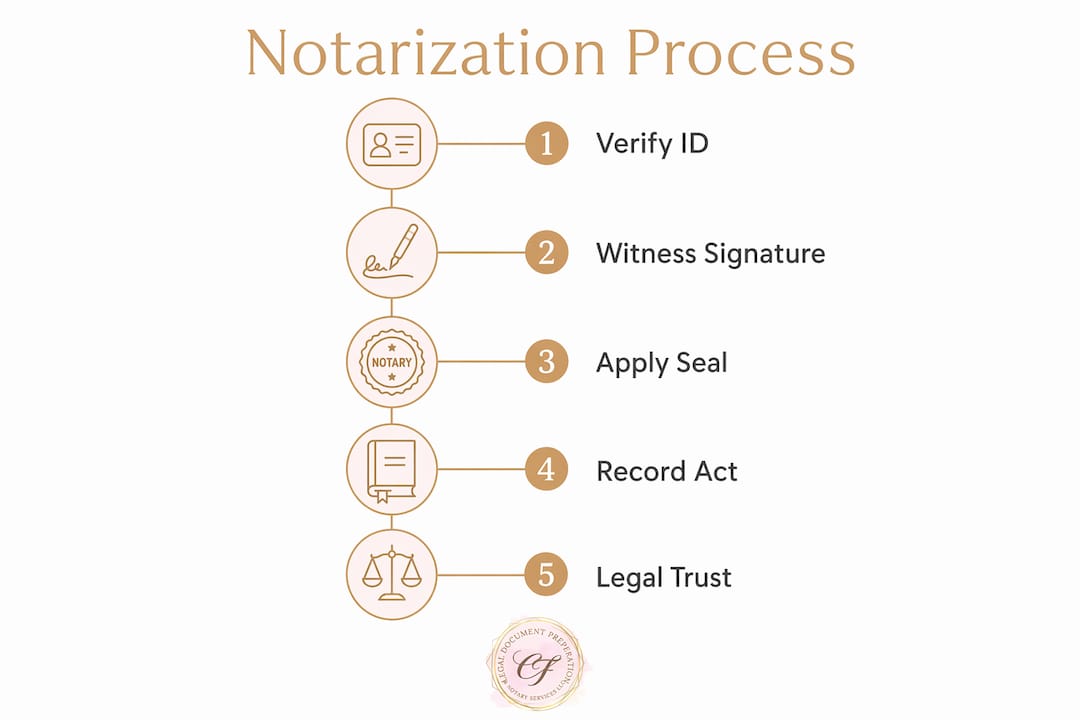
Beyond the rules of evidence, courts apply the presumption of regularity to notaries as commissioned public officials. The court starts from the position that the notary followed every required step correctly. That assumption puts challengers in a difficult spot from the beginning.
Key reasons courts and agencies rely on notarized documents:
- Self-authentication: Admitted into evidence without live witness testimony under Federal Rule of Evidence 902(8)
- Presumption of regularity: Courts assume the notary performed their duties correctly unless proven otherwise
- Fraud deterrence: An impartial, state-commissioned officer creates a paper trail that deters forgery and identity theft
- Reduced court burden: Prima facie evidence of proper execution eliminates routine authentication disputes
- Overlapping presumptions: On commercial instruments, notarization combines with UCC Section 3-308's statutory presumption of authenticity, making forgery claims exceptionally difficult to sustain
The National Notary Association reports that nearly five million notaries serve the United States, collectively supporting millions of real estate transactions, estate plans, and business agreements each year. That scale reflects how deeply the legal system depends on notarization to maintain the integrity of recorded instruments.
In practice, a notarized deed means the person disputing a property transfer carries the full burden of proving fraudulent conveyance. A will with a notarized self-proving affidavit can be admitted to probate without live testimony from the witnesses who watched the testator sign. These are not minor conveniences. They are the difference between a document that moves through the legal system efficiently and one that gets tied up in authentication disputes.
Limitations and common grounds for challenging notarized documents
Notarization is not a guarantee of enforceability, and courts are clear about where its protection ends. Understanding these limits helps you avoid placing false confidence in a seal.
The most common misconception is that notarization validates the document's substance. It does not. A notarized agreement with illegal terms, unconscionable clauses, or a party who lacked legal capacity is still defective. The notary's seal confirms the act of signing, nothing more. Legal experts consistently warn against assuming notarization validates contract terms.
Procedural failures that can void a notarization:
- Signer never physically appeared before the notary
- Notary was not properly commissioned at the time of the act
- No valid government-issued ID was checked
- Notary had a disqualifying interest in the document
- Notarial certificate was incomplete or missing required elements
Substantive grounds for challenging a notarized document:
- Forgery or identity fraud at the time of signing
- Duress or coercion that undermined voluntary consent
- Undue influence, particularly in estate planning contexts
- Signer lacked mental capacity to execute the document
- Fraud in the inducement, where the signer was misled about the document's nature
Challenging a notarized document requires clear and convincing evidence, a higher bar than the preponderance standard used in most civil cases. The challenger must show a defect is highly probable, not merely more likely than not. That standard exists because millions of real estate transactions and estate plans rest on notarized signatures. Allowing casual challenges would destabilize the entire system of recorded instruments.
Minor technical errors, such as a misspelled name, a misplaced seal, or an omitted middle initial, often do not invalidate a document. Many states have enacted statutes that cure these clerical mistakes. The line is drawn at substantive failures. If the signer never appeared before the notary, or the notary was not commissioned, no curative statute applies. Courts treat those defects as going to the heart of the notarial act itself.
Proving undue influence is particularly difficult when a notarized signature is involved, because the notary's certificate implicitly affirms the signer appeared willing. A challenger typically needs to show a confidential relationship between the signer and the alleged influencer, active involvement by that person in procuring the document, and a result that benefits them at the signer's expense. Even then, courts resist setting aside a notarized signature without strong, specific evidence.
How to ensure your notarized documents hold up legally
Getting a document notarized is straightforward. Getting it notarized correctly, so it survives a legal challenge, requires attention to a few specific details.
Choose a commissioned, impartial notary. The notary must be currently commissioned in the state where the notarization occurs and must have no personal or financial interest in the document. A notary who is also a party to the agreement, or who stands to benefit from it, has a disqualifying interest and cannot legally perform the act. For state-specific requirements, the Florida notarization checklist outlines what applies in Florida.
Ensure all signers appear in person. Physical presence before the notary is required in most states for standard notarizations. Remote online notarization is available in many states, including Florida, but it follows its own set of procedural requirements. Skipping personal appearance is one of the most common defects that voids a notarization entirely.
Best practices to protect your notarized documents:
- Bring a valid, unexpired government-issued photo ID for every signer
- Confirm the correct notarial act for your document type (acknowledgment vs. jurat)
- Verify that the notarial certificate is fully completed before leaving
- Request that the notary record the transaction in their official journal
- Ask whether a thumbprint is appropriate for high-stakes documents like deeds or powers of attorney
- Keep a certified copy of the notarized document in a secure location
- Use clear, unambiguous language in the document itself, since notarization does not fix vague or contradictory terms
If your document will be used across state lines, understanding state vs. federal notary rules helps you confirm it will be recognized where it needs to be. For international use, additional authentication steps like an apostille may be required.
Pro Tip: Electronic notarization adds a layer of security that traditional ink-and-seal notarization cannot match. A tamper-evident digital certificate based on public key infrastructure (PKI) technology verifies the notary's identity and makes any post-signing alteration immediately visible. If the document is changed after notarization, the digital signature becomes invalid. That built-in integrity check is especially valuable for business contracts and loan documents.
Expert insights on the role of notarization in legal document preparation
Legal professionals and experienced document preparers point to a consistent set of misunderstandings that create problems for individuals and small business owners alike.
Notarization certifies the act, not the substance. The notary seal is often described as the "guarantor of integrity" for the signing process, but it does not validate what the document says. A notarized affidavit containing false statements is still a false affidavit. The signer swears to the truth under penalty of perjury, but the notary does not independently verify those statements. Courts understand this distinction precisely, and the evidentiary weight of notarization reflects it.
The notary journal is an underused legal tool. Most people focus on the seal and signature, but the notary's official journal provides a permanent, auditable record that can be critical if the document is later lost or disputed. The journal entry documents the date, the signer's identity, the type of notarial act, and the ID presented. That contemporaneous record helps courts confirm the transaction occurred exactly as stated, even years later.
Rebuttable presumption is powerful but not absolute. Notarization creates a strong legal presumption of authenticity, but it remains rebuttable. Clients sometimes treat a notarized document as bulletproof, which leads to poor decisions in contract drafting and estate planning. The presumption shifts the burden of proof to challengers, but a well-documented fraud claim or a clear procedural defect can still overcome it.
Common pitfalls in practice:
- Assuming the notary will catch errors in the document's terms or legal sufficiency
- Failing to bring valid ID, which forces a rescheduled appointment and delays
- Using a notary who is also a party to the transaction, creating a disqualifying conflict
- Neglecting to keep a copy of the notarized document after the appointment
- Misunderstanding that notarization does not substitute for an attorney's review of complex agreements
For small business owners, notarized documents play a direct role in the reliability of contracts, LLC formation records, and loan agreements. When updating formation documents after ownership changes or expansion, proper notarization of the updated records protects the business from future disputes about who authorized what and when.
The notary's role is defined by state law and limited to witnessing and authenticating signatures. That limitation is a feature, not a flaw. It keeps the notary impartial and ensures the process serves everyone at the table equally. When you understand what notarization does and does not do, you can use it as the precise legal tool it was designed to be.
Key Takeaways
Notarized documents hold legal weight because notarization creates a rebuttable presumption of authenticity, shifts the burden of proof to challengers, and grants self-authenticating status under Federal Rule of Evidence 902(8).
| Point | Details |
|---|---|
| Self-authentication in court | Under Federal Rule of Evidence 902(8), notarized acknowledgments are admitted without live witness testimony. |
| Rebuttable presumption | Courts presume proper execution; challengers must meet the clear and convincing evidence standard to overcome it. |
| Notarization scope | The notary seal certifies the signer's identity and willingness, not the accuracy or legality of the document's contents. |
| Challenge threshold | Serious defects like signer non-appearance or an uncommissioned notary are not cured by state statutes. |
| Best practice | Complete notarial certificates, journal entries, and valid ID checks are the foundation of documents that hold up legally. |
Work with a trusted notary who gets it right the first time
When a document needs to hold up in court, at a government agency, or in a real estate closing, the notarization has to be done correctly from the start. Cflegalformhelp provides professional mobile notary and document preparation services with flat-fee pricing and bilingual support in English and Spanish. Whether you need a deed, a power of attorney, an affidavit, or business formation documents notarized, Cflegalformhelp handles the process with the care and accuracy your documents deserve. For individuals and small business owners in South Florida, legal document preparation through Cflegalformhelp means you get it done right, without surprises.