
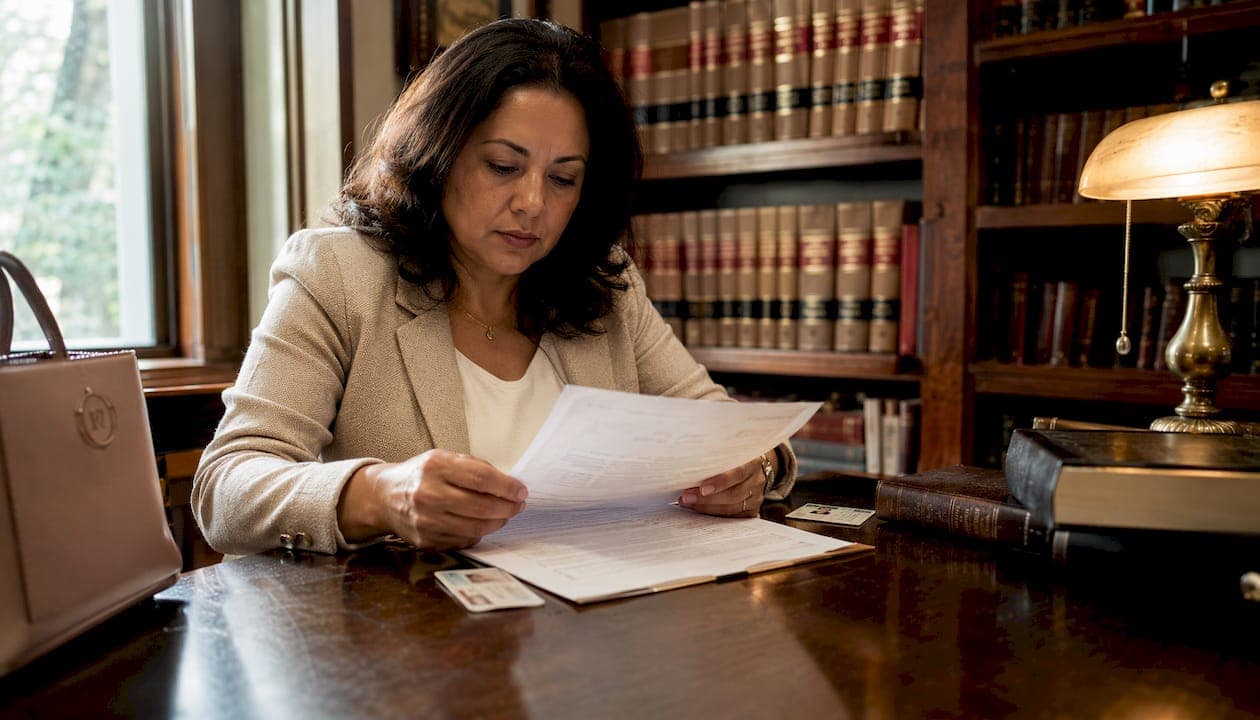
A notarial certificate is the formal written statement that a notary public completes, signs, and seals to record and authenticate a notarial act. Under 22 CFR § 92.1, it is defined as "the signed and sealed statement to which a notarial act is almost invariably reduced." Without it, the notarization is legally incomplete, regardless of whether a stamp appears on the page.
Here is what the certificate does at a glance:
- Proves personal appearance: It confirms the signer appeared before the notary in person (or via authorized remote session).
- Records the type of act: It states whether the notary witnessed a signature, administered an oath, or took an acknowledgment.
- Establishes legal sufficiency: Banks, courts, and recording offices rely on the certificate wording, not the stamp alone, to confirm the notarization was properly performed.
- Signals incompleteness when absent: A document that lacks proper certificate wording cannot be legally notarized, even if the notary's seal is present.
Table of Contents
- What does a notarial certificate actually prove?
- What are the four parts of a notarial certificate?
- What types of notarial certificates are there?
- What does sample certificate wording look like?
- Can a document be notarized without certificate wording?
- What does a notary actually do during a notarization?
- How do notarial certificate rules vary by state?
- Who keeps the notarial certificate after notarization?
- Common misconceptions about notarial certificates
- When do you need a notarial certificate?
- Key Takeaways
- Why the certificate wording matters more than most people realize
- Useful sources for further reading
What does a notarial certificate actually prove?
The certificate is the notary's official written record of what happened during the notarial act. It tells any relying party, such as a bank, a court clerk, or a title company, exactly what the notary did and what was confirmed at the time.
"The notarial certificate attests to the performance of the act by the notary, and may be an independent document or, as in general American notarial practice, may be placed on or attached to the notarized document." — 22 CFR § 92.1, via the Legal Information Institute
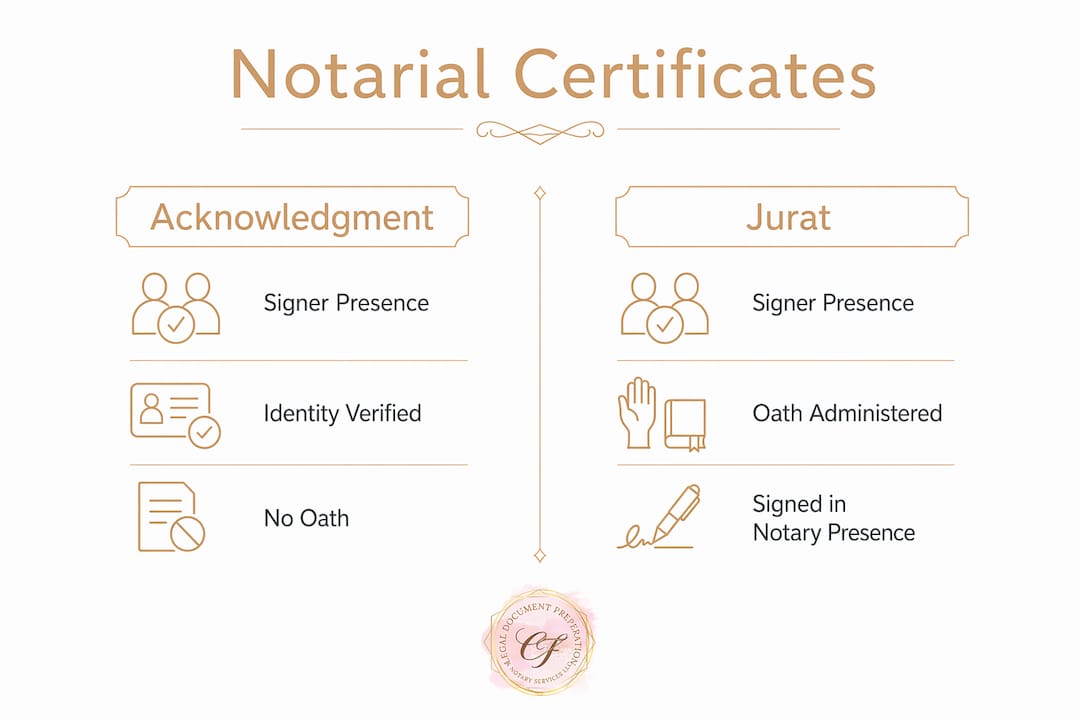
What the certificate proves depends on its type. An acknowledgment certificate proves that the signer personally appeared, was identified, and voluntarily acknowledged signing the document. A jurat proves that the signer appeared, signed in the notary's presence, and swore or affirmed that the document's contents are true. Neither type proves that the underlying facts in the document are accurate. A notary is not verifying the truth of what a deed says about property boundaries or what an affidavit claims about an event. The certificate proves the process was followed correctly, not that the content is correct.
This distinction matters when a document is challenged. Courts and recording offices look at the certificate wording to determine whether the notarization was valid. The legal weight of a notarized document rests almost entirely on whether that wording is present, complete, and accurate.
What are the four parts of a notarial certificate?
The National Notary Association identifies four core components that appear in notarial certificates across most U.S. jurisdictions. Knowing each one helps you spot a certificate that is missing information before it causes a rejection.
- Venue: The state and county where the notarization takes place. It appears at the top of the certificate, typically formatted as "State of ____, County of ____." This establishes the jurisdiction and confirms the notary was commissioned in that location.
- Body: The substantive text of the certificate. It names the signer, states the date, identifies the type of act performed, and contains the required legal wording for that act. This is where acknowledgment language or jurat language appears.
- Notary's signature: The notary signs exactly as their name appears on their commission. A signature that does not match the commissioned name can cause a recording office to reject the document. Notaries must sign certificates exactly as their commission records show.
- Notary's seal or stamp: The official seal confirms the notary's authority. Some states require an embossed seal; others accept an inked rubber stamp. The seal must be legible and placed near the signature without covering any text.
Some states require additional fields in the body or near the seal. These commonly include the type of identification the signer presented, the notary's commission number, and the commission expiration date. Checking your state's notary handbook before completing a certificate is the safest way to confirm what is required.
Pro Tip: If your seal impression comes out faint or smudged, apply a second impression nearby and initial it to indicate which one is official. Never trace over or rewrite a poor impression, as that creates an ambiguous record that can raise fraud concerns.

What types of notarial certificates are there?
Different notarial acts require different certificate types. The type you need depends on what the document requires and what the requesting party specifies. Here is a comparison of the most common certificate types used in the United States.

| Certificate type | What it proves | Key wording to look for | Common use cases |
|---|---|---|---|
| Acknowledgment | Signer appeared, was identified, and voluntarily signed | "acknowledged before me" | Deeds, powers of attorney, mortgages |
| Jurat | Signer appeared, signed in notary's presence, and swore/affirmed contents are true | "subscribed and sworn to before me" | Affidavits, sworn statements, court filings |
| Oath or affirmation | Signer took a verbal oath or affirmation | "sworn" or "affirmed before me" | Public office oaths, depositions |
| Copy certification | Notary certifies a copy is a true and accurate reproduction of the original | "true and correct copy" | Diplomas, licenses, personal records |
| Witnessing a signature | Notary witnesses the physical act of signing | "signed before me" | Contracts, agreements, some wills |
The acknowledgment and jurat are the two types you will encounter most often. A deed almost always requires an acknowledgment. An affidavit almost always requires a jurat. When a document does not specify which type is needed, the requesting party, such as a court, a lender, or a government agency, should tell you. The notary cannot make that decision for you.
What does sample certificate wording look like?
Seeing the actual language helps you recognize whether a certificate is correct. Below are short examples of the wording used in the two most common certificate types, with notes on what each phrase means.
Acknowledgment certificate (sample):
"State of Florida, County of Collier. Before me, the undersigned authority, personally appeared [Signer Name], known to me or who produced [ID type] as identification, and acknowledged that he/she executed the foregoing instrument for the purposes therein expressed. Witness my hand and official seal this [date]."
- "Personally appeared" confirms physical presence before the notary.
- "Known to me or who produced identification" records how identity was verified.
- "Acknowledged that he/she executed" confirms the signer voluntarily signed, not that the content is true.
Jurat certificate (sample):
"State of Florida, County of Collier. Subscribed and sworn to (or affirmed) before me this [date] by [Signer Name], who is personally known to me or produced [ID type] as identification."
- "Subscribed and sworn to before me" means the signer signed the document in the notary's presence and took an oath that the contents are true.
- The date must match the date the signer actually appeared and signed, not the date the document was drafted.
Witnessing statement (sample):
"Signed before me this [date] by [Signer Name]."
This shorter form simply records that the notary watched the signer execute the document. No oath is administered.
When a loose certificate is attached rather than printed on the document, it should also reference the document title and date so it cannot be detached and reused on a different document. Cross-referencing is a standard anti-fraud practice.
Can a document be notarized without certificate wording?
No. A notary cannot proceed without correct certificate wording present on or attached to the document. If the document you bring to a notary has no certificate language, you have two practical options.
Option 1: Add the wording directly to the document. If there is space at the bottom of the document, the notary can type or write the appropriate certificate wording before completing the notarization. This keeps everything on one page and is the cleaner solution when space allows.
Option 2: Attach a loose notarial certificate. A loose certificate is a separate page containing the certificate wording. The notary completes it, signs and seals it, and staples it to the document. This is a widely accepted practice, and most notaries keep a supply of pre-printed loose acknowledgment and jurat certificates for exactly this situation.
One important boundary: the signer or the requesting party must specify which type of certificate is needed. The notary cannot choose for you. Selecting the certificate type could be considered the unauthorized practice of law, which notaries are prohibited from engaging in.
Pro Tip: When attaching a loose certificate, write the document title and date on the certificate itself before stapling. This cross-reference prevents the certificate from being separated and reattached to a different document, which is a real fraud risk.
What does a notary actually do during a notarization?
Understanding the notary's role helps you prepare for the appointment and know what to expect. The process follows a consistent sequence across most states.
- Verify the signer's identity. The notary checks a government-issued photo ID. Acceptable forms typically include a driver's license, passport, or state ID card. Some states specify which IDs are acceptable.
- Confirm personal appearance. The signer must be physically present before the notary, or present via an authorized remote online notarization platform such as NotaryCam, where permitted by state law.
- Review the document for completeness. The notary scans the document to confirm certificate wording is present, no blank spaces remain that could be filled in later, and the document appears complete. The notary does not read or verify the content.
- Administer the oath or take the acknowledgment. For a jurat, the notary administers a verbal oath or affirmation and the signer signs in the notary's presence. For an acknowledgment, the signer confirms they signed voluntarily; they may have signed beforehand.
- Complete the certificate. The notary fills in the venue, date, signer's name, and any other required fields in the certificate body.
- Sign and seal. The notary signs exactly as commissioned and applies the official seal near the signature.
- Record the act in the journal. Many states require notaries to keep a journal entry for each notarial act, recording the date, type of act, document description, signer's name, and ID type used.
What the notary may not do is equally important. A notary cannot advise you on which certificate type your document requires, explain the legal effect of what you are signing, or tell you whether the document is legally sufficient for its purpose. Those questions require an attorney. The notary's role is that of an impartial witness, not a legal advisor. For a clear breakdown of how these roles differ, see notary, witness, and signer roles.
How do notarial certificate rules vary by state?
Notarial certificate requirements are set by state law, and they vary more than most people expect. What is acceptable wording in Florida may be insufficient in California, and a state that does not require a seal may still require a commission number on the certificate.
Common variations include:
- Required wording: Some states publish statutory certificate forms that must be used verbatim. Others accept any wording that substantially complies with the required elements.
- Seal requirements: Most states require a seal or stamp, but a few do not. Where seals are required, the format (embossed vs. inked) and required content (name, state, commission number, expiration) differ.
- Commission number and expiration date: Some states require these on the certificate itself; others only require them on the seal.
- ID recording: Several states require the notary to record the type of identification presented, either in the certificate body or in the journal.
- Loose certificates: Most states permit them, but some have specific rules about how they must be formatted or attached.
For a state-specific example, the Florida notarization requirements checklist covers the wording, seal, and journal rules that apply in Florida. For documents that will be used in another state or country, the state vs. federal notary documents guide explains when federal standards apply and what additional authentication may be needed.
The most reliable source for your state's exact requirements is your state's secretary of state website or the official notary handbook published by your commissioning authority.
Who keeps the notarial certificate after notarization?
The completed certificate stays attached to the document and goes with the signer or the requesting party. The notary does not retain the original document or the certificate. What the notary does keep is a separate record in their notarial journal.
Key points on retention:
- The signer or requesting party keeps the document. Once notarized, the document with its attached certificate is returned to whoever requested the notarization. They are responsible for storing it safely.
- The notary keeps a journal entry. Most states require notaries to record each act in a bound journal. The entry typically includes the date, type of act, document description, signer's name and address, ID type, and the notary's fee.
- Seals and journals must be secured. Leaving a seal or journal unsecured can be a misdemeanor in some states. Notaries are generally required to store both in a locked location accessible only to them.
- Journal retention periods vary. Some states require journals to be kept for a set number of years after the last entry; others require them to be surrendered to the county clerk upon the notary's death or resignation.
- Loose certificates need special care. If a loose certificate was attached, both the certificate and the document should be stored together. Separating them defeats the cross-referencing that prevents misuse.
For document types where the original may eventually be lost or disputed, such as wills or powers of attorney, keeping a certified copy with the notarial certificate intact is a practical precaution. A lost will scenario illustrates exactly why proper notarization and secure storage of the original matter so much.
Common misconceptions about notarial certificates
A few persistent misunderstandings cause real problems for signers and notaries alike. Clearing them up saves time and prevents rejected documents.
Misconception 1: The stamp alone makes the notarization valid. The American Society of Notaries is direct on this point: the certificate wording is the legal substance of the notarization. A stamp with no certificate language, or with incorrect certificate language, does not create a valid notarization. Recording offices and courts read the words, not just the ink. For a deeper look at what the seal does and does not do, see what a notary seal means.
Misconception 2: The notary chooses which certificate type to use. Notaries are prohibited from advising signers on which notarial act they need. Doing so could constitute the unauthorized practice of law. The requesting party, whether that is a court, a lender, or a government agency, must specify the required act. If no one has told you which type of certificate your document needs, contact the agency or institution that will receive it before your notary appointment.
Misconception 3: For a jurat, the signer can sign before the appointment. A jurat requires the signer to sign in the notary's presence. Signing beforehand and then presenting the document for a jurat is improper and can invalidate the notarization. Bring the document unsigned if a jurat is required.
Misconception 4: Any signature style works for the notary. Notaries must sign certificates exactly as their name appears on their commission. A notary who signs with a nickname or an abbreviated version of their commissioned name risks having the document rejected by a recording office.
Practitioners also recommend scanning the document before completing the certificate to confirm no blank spaces remain. Blank spaces left in a document create opportunities for unauthorized additions after notarization, which is a recognized fraud risk.
When do you need a notarial certificate?
Many common documents require notarization as a condition of legal acceptance. Knowing which ones typically require a certificate helps you prepare the right paperwork before your appointment.
- Real estate documents: Deeds, mortgages, and property transfer documents almost always require a notarized acknowledgment certificate. Recording offices will not accept them without it.
- Powers of attorney: A durable or general power of attorney typically requires an acknowledgment in most states. Some states require two witnesses in addition to notarization.
- Affidavits and sworn statements: These require a jurat because the signer is swearing to the truth of the document's contents under penalty of perjury.
- Loan documents: Mortgage closings and refinancing packages include multiple documents requiring notarized acknowledgments. Loan signing agents handle these routinely.
- Corporate and business filings: Some states require notarized signatures on articles of incorporation, LLC operating agreements, or certain business resolutions.
- Certified copies: When an original document cannot be submitted, a notarized copy certification may be required. Not all states permit notaries to certify copies of all document types, so confirm with the requesting agency.
- Immigration forms: Certain affidavits of support and sworn declarations submitted to federal agencies require a jurat.
When you are unsure which certificate type a document requires, contact the agency or institution that will receive it. Do not ask the notary to decide.
Key Takeaways
A notarial certificate is the signed and sealed written statement that makes a notarization legally complete, and its wording, not the stamp, is what relying parties rely on.
| Point | Details |
|---|---|
| Certificate wording is the legal substance | A stamp without correct certificate language does not create a valid notarization. |
| Four standard parts | Every certificate needs a venue, body, notary signature, and seal to be complete. |
| Signer chooses the certificate type | The requesting party specifies the act; the notary cannot choose for you. |
| Missing wording can be fixed | Add wording directly to the document or attach a stapled, cross-referenced loose certificate. |
| State rules vary | Always confirm required wording, seal format, and journal rules with your state's notary handbook or secretary of state. |
Why the certificate wording matters more than most people realize
Most people walk into a notary appointment focused on the stamp. They want to see that official seal pressed onto the page, and once they see it, they assume the job is done. In practice, the stamp is the least important part of a valid notarization.
What a court, a lender, or a recording office actually reads is the certificate wording. Those few lines of text tell the relying party what the notary confirmed, when it happened, and under what circumstances. A document with a clear, dark seal impression and no certificate language is not notarized. A document with faint ink but complete, accurate certificate wording is.
The practical implication is this: before you leave a notary appointment, read the certificate. Confirm the signer's name is spelled correctly, the date matches the day of the appointment, and the wording matches the type of act you requested. A jurat that says "acknowledged" instead of "subscribed and sworn to" is the wrong certificate for an affidavit, and it may cause the document to be rejected.
The other thing most people underestimate is the importance of specifying the certificate type before the appointment. Calling the court clerk, the lender, or the government agency in advance to ask which act is required takes five minutes and prevents a second appointment. Notaries at Cflegalformhelp see this issue regularly: a signer arrives with a document, no one has confirmed the required act, and the appointment cannot proceed until the requesting party is contacted.
Preparation is straightforward. Bring a valid government-issued photo ID, bring the document unsigned if a jurat is required, and know which certificate type you need. Those three steps cover the majority of notarization problems before they happen.
Useful sources for further reading
These are the primary references used throughout this article. Each one is worth bookmarking if you work with notarized documents regularly.
- 22 CFR § 92.1 via Cornell Law School LII: The federal regulatory definition of a notarial certificate. This is the authoritative starting point for understanding what the certificate is and what it must contain.
- National Notary Association (NNA): The NNA publishes practical guidance on certificate parts, sample wording, and state-specific rules. Their notary bulletin is a reliable resource for both notaries and signers.
- American Society of Notaries: Covers the legal significance of certificate wording and addresses common misconceptions, including the seal-only myth.
- State secretary of state websites: Each state's commissioning authority publishes a notary handbook with required wording, seal specifications, journal rules, and acceptable ID types. Search "[your state] notary handbook" to find yours.
- Cflegalformhelp mobile notary and loan signing services: If you need a notarization completed correctly the first time, Cflegalformhelp provides professional mobile notary and loan signing services with bilingual support in English and Spanish.
This article is general information about notarial certificates in the United States and is not legal advice. Certificate requirements vary by state and document type. Confirm the current rules with your state's commissioning authority or a qualified attorney for your specific situation.